
- Published First On BBC News.
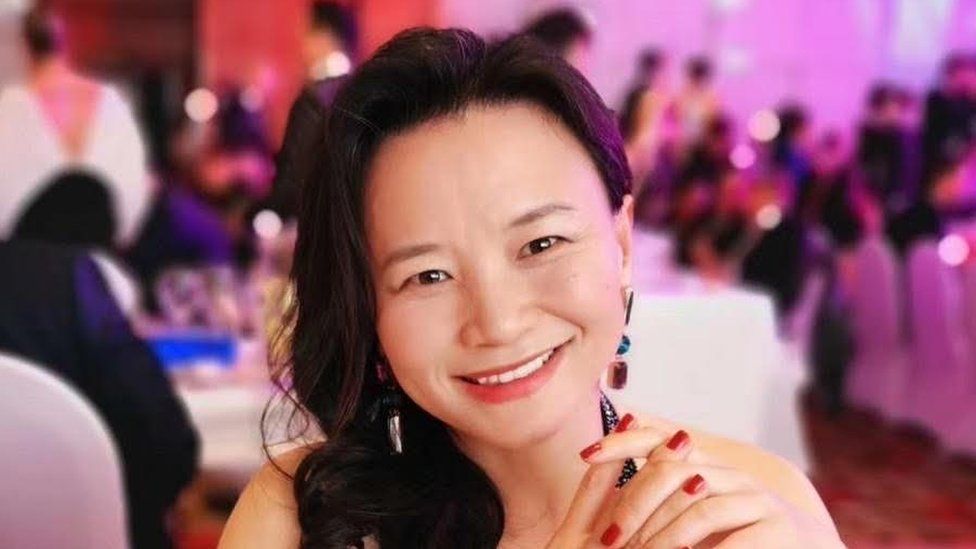
"One thousand days is a shockingly long time in detention," says Nick Coyle.
He
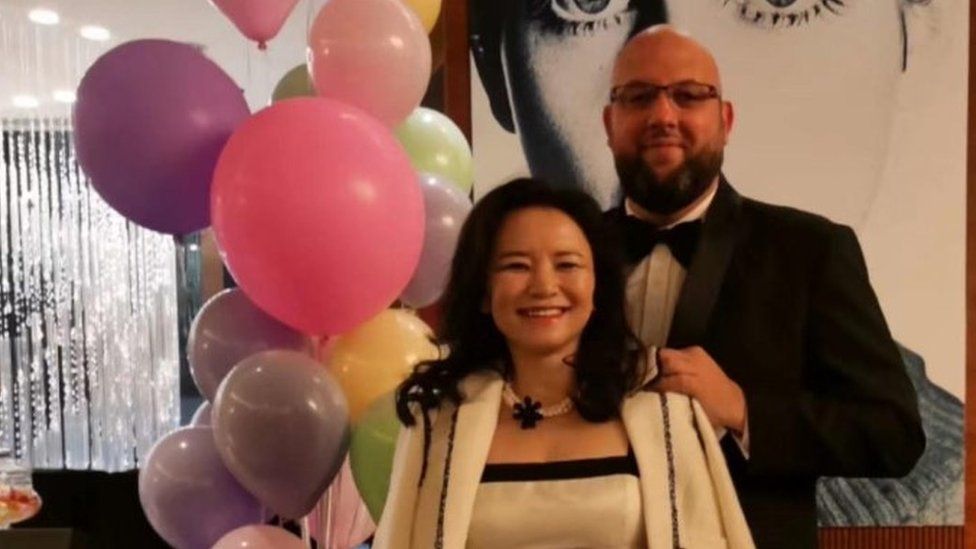
is speaking about his partner, Australian journalist Cheng Lei, who
remains in a Chinese prison. The details of the charges against her are
still a secret and she has not been sentenced.
Like
Ms Cheng's other friends and family, Mr Coyle says he still has no idea
what she is supposed to have done to warrant this treatment.
"I would call upon the relevant authorities in China to resolve this awful situation as quickly as possible," he tells the BBC.
Cheng
Lei was working as a business reporter at China's state-run English
language television station CGTN when she was suddenly grabbed by state
security officers on 13 August 2020, and later accused of "illegally
supplying state secrets overseas".
Her
first six months were spent in solitary confinement, being placed in
stress positions and, though being interrogated, with no access to a
lawyer.
Since then, she has been held with other prisoners.
Her
trial took place in March last year behind closed doors. Even
Australia's Ambassador to China Graham Fletcher was denied entry.
But her sentencing has been postponed again and again.
Calls by the BBC to the Beijing Second Intermediate People's Court, where her trial was held, went unanswered.
Mr
Coyle - the former chief executive of the China-Australia Chamber of
Commerce - has now left Beijing but continues to work from overseas for
her release.
"I
took China's ambassador to Australia, Xiao Qian, at his word in January
when he expressed hope 'that a solution will come as soon as
possible'," Mr Coyle says. "Five months later we are still waiting".
Another
Australian who's been imprisoned following state secrets charges, Yang
Hengjun, has also had his sentencing repeatedly postponed.
In
China, what might be considered a "state secret" is a sweepingly
general concept and can essentially be whatever the government wants it
to be.
For
a country trying to attract international business investment back to
its shores after years of extremely strict Covid lockdown measures, the
detention of foreigners for extended periods under an opaque,
party-controlled legal system is proving to be a challenge.
Canadians Michael Kovrig and Michael Spavor were held under a form of hostage diplomacy, from 2018 to 2021, in response to extradition proceedings against Huawei's chief financial officer Meng Wanzhou.
They were released hours after the US extradition request against her was dropped.
Yet the pressure on foreign companies remains.
Six weeks ago, a Japanese executive from a pharmaceutical company was detained,
and China's foreign ministry said he was suspected of carrying out
espionage activities. In recent weeks, international corporate research
firms have also been raided here.
Many
would-be foreign investors are weighing up the risks of remaining in
China but also feel they can't ignore the obvious appeal of the
country's massive domestic market.
Australia and China have a had a rocky few years. Beijing placed sanctions on Australian wine,
barley and lobsters. In this country with more than 5% of the entire
population tracing their roots back to China, the tensions have been
considerable.
Amidst all this friction, Cheng Lei's case has drawn a lot of attention.
Over
the years, the treatment of foreign passport holders with Chinese
ancestry has been different to other foreigners when it comes to
detention in China: in short, much more strict.
However,
if the Chinese government thought that Australians would be less
concerned about Cheng Lei because she's ethnically Chinese, this has not
been the case.
When
she was picked up, her children were nine and 11. That they have not
been able to see their mother all this time has resonated in Australia
and beyond.
"Fair-minded
Australians - from business to political leaders and in the general
public - do not accept the status quo," Nick Coyle says.
China's foreign ministry has tried to water down global concerns regarding the case.
At
a regular press briefing, spokesman Wang Wenbin said: "China's judicial
authorities have handled the case in accordance with the law, fully
protecting Cheng Lei's legal rights."
On
the second anniversary of her detention, he said that judgement would
be passed "in due course". However, more than a year after her secret
trial, there has still been no "judgement".
Being
charged with an offence in China almost certainly means losing. The
official conviction rate is nearly 100%. Lawyers and supporters do what
they can to minimise the punishment the accused might face under these
circumstances.
When
it comes to foreigners, their governments attempt to negotiate with
their Chinese counterparts to secure the release of their citizens. This
can sometimes involve deals.
The
Chinese government would like to see a visit to Beijing by Australian
Prime Minister Anthony Albanese later this year, to formalise a recent
thaw in relations.
The
cases involving Cheng Lei and Yang Hengjun could be used as a
bargaining chips by the Australian side to clear the path for this visit
to take place.
The Australian Government says it has raised their cases on many occasions.
Last
week, while he was in London for the Coronation, Mr Albanese said
during a television interview that "our position on China has been to
engage constructively but to continue to put forward that the
impediments to trade should be removed, to say very directly to
President Xi, that Australians such as Cheng Lei need to be given proper
justice, and that they're not receiving".
It will not have gone unnoticed in Beijing that he mentioned Xi Jinping by name.
Much
of Cheng Lei's career had been spent trying to build bridges between
the country of her birth and the country her family moved to.
That her case has pushed China and Australia further apart is not something she would have wanted.
In
the limited messages from her that are able to come out of the prison
via monthly half-hour visits by Australian diplomats, one thing seems to
dominate: how much she misses her children and the extent of the pain
she feels being away from them.
Nick
Coyle says her children, now 11 and 14, have been doing their best to
grow up in Australia without their mum, but "for Lei and her kids' sake,
I really hope a solution to all this can be found urgently".

