
Sweden's Loreen has won the Eurovision Song Contest for the second time, with her soaring pop anthem Tattoo.
The star, who last won the competition in 2012, saw off competition from Finland's Käärijä in a nail-biting vote.
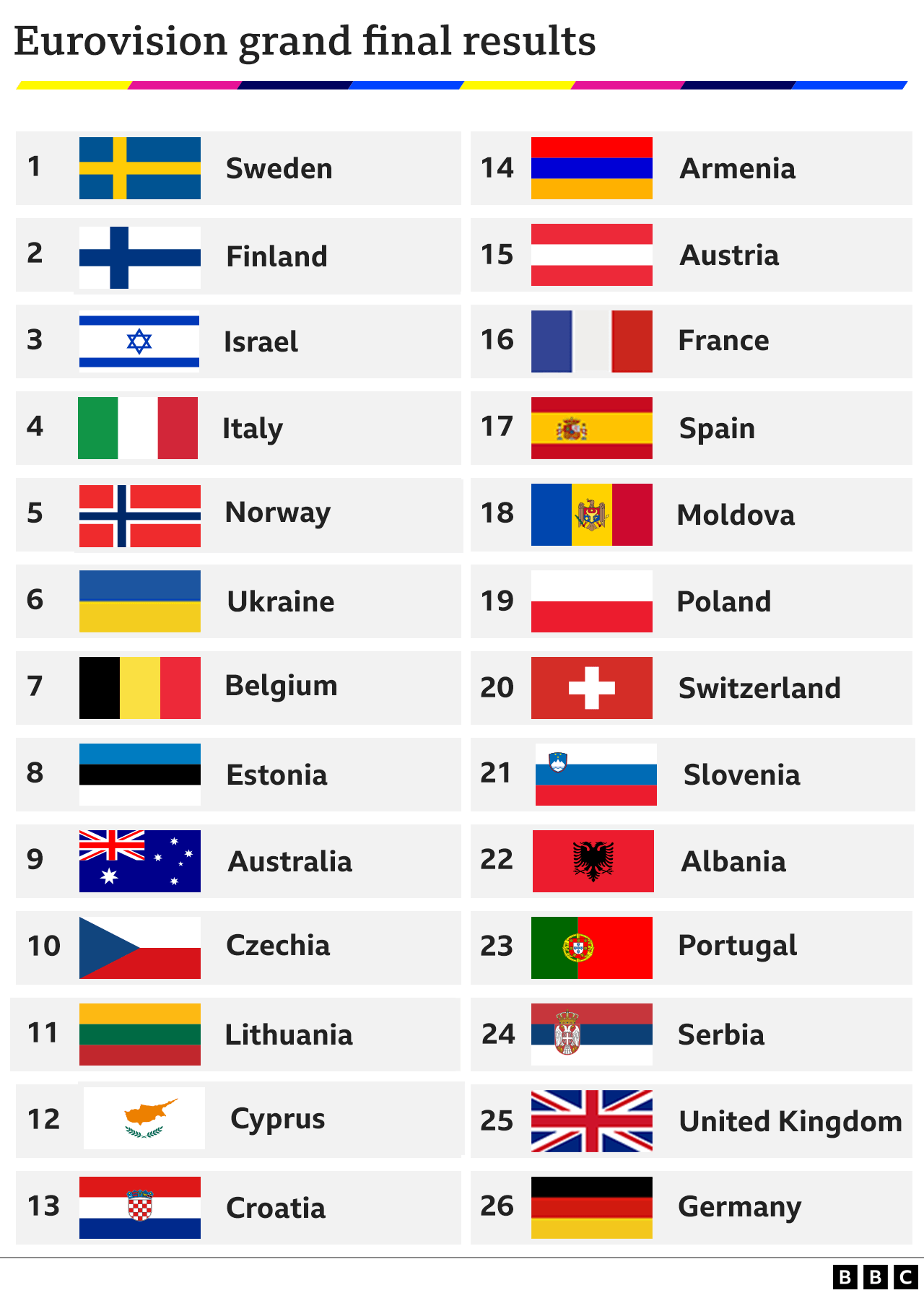
The UK's Mae Muller failed to replicate Sam Ryder's success last year, coming in 25th place - one above bottom.
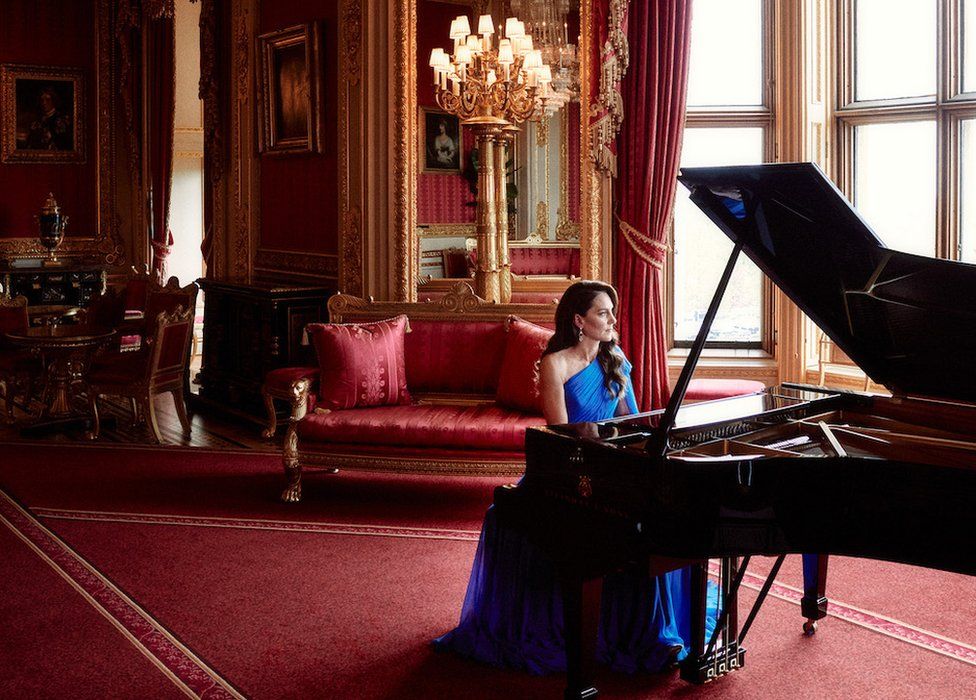
And the Princess of Wales made a surprise cameo, playing the piano with last year's winners Kalush Orchestra.
Loreen is the only the second person - and the first woman - to win Eurovision twice, following Ireland's Johnny Logan.
"This is so overwhelming," she said as she collected the trophy. "I'm so grateful. I'm so thankful."
"In my wildest dreams, I didn't think this would happen."
Sweden's
victory means it will host next year's competition - on what will be
the 50th anniversary of Abba's historic victory with Waterloo in 1974.
But
Ireland crashed out of this year's contest at the semi-final stage for
the fifth year in a row - a result their head of delegation described as
"devastating".
This year's top three acts were:
- Sweden: Loreen - Tattoo (583 points)
- Finland: Käärijä - Cha Cha Cha (526 points)
- Israel: Noa Kirel - Unicorn (362 points)
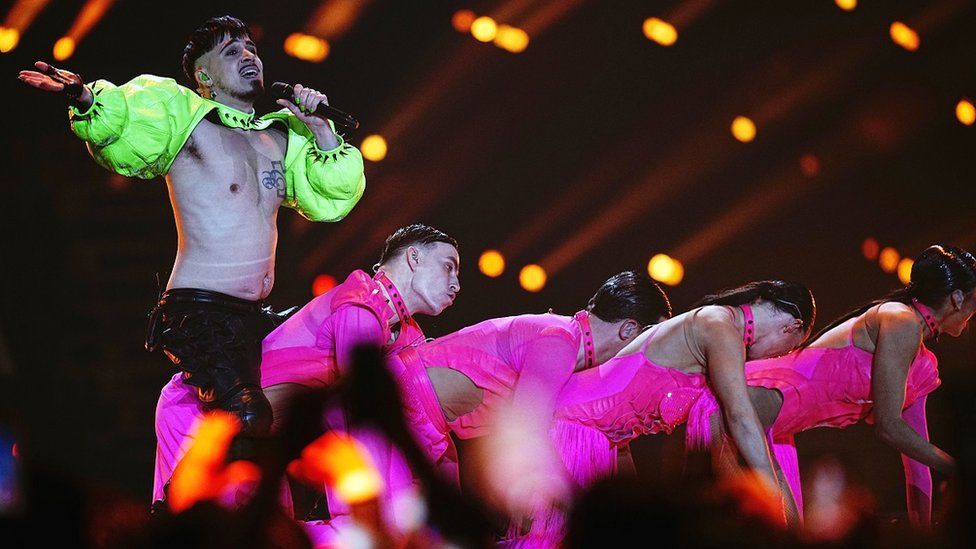
Mae Muller only picked up 24 points, leaving the UK near the bottom of the leaderboard. It was "not the result we hoped for," she tweeted after the show.
"I
know I joke a lot but we really put our all into the last few months,"
she said. "Congrats to all the countries, I'll never forget this journey
and I love you all."


Liverpool hosted this year's contest on behalf of war-torn Ukraine, which won in 2022.
Appropriately,
the show began with last year's winners, Kalush Orchestra, playing an
extended version of their song Stefania in a pre-taped segment from
Kyiv.
Stars
including Joss Stone, Sam Ryder and Andrew Lloyd Webber added a British
flavour to the song, as the band boarded a train from Kyiv's iconic
Maidan Nezalezhnosti metro station and arrived on the stage of the
Liverpool Arena.
The
Princess of Wales accompanied on piano, in a brief segment recorded in
the crimson drawing room of Windsor Castle earlier this month.
Back
in the arena, Kalush performed their new single Changes, delivering a
message of defiance to Russia: "Give my all down to the wire / Set me
free."
It was the first of many references to the war, in a show that took a more political tone than most editions of Eurovision.
Croatia's
Let 3! performed a song that referred to Russia's Vladimir Putin as a
"crocodile psychopath", while the Czech band Vesna sang in Ukrainian,
"We're with you in our hearts".
Ukraine's own entry, Tvorchi, played a powerful song inspired by the siege of Mariupol.
The duo's hometown of Ternopil was hit by Russian missiles moments before the band took to the stage in Liverpool, officials said.
They eventually took sixth place, with a total of 243 points.
Russia
has been suspended from the contest due to the invasion, but organisers
refused to allow a speech from Ukraine's President Volodomyr Zelensky
during the show.
Elsewhere,
Eurovision was Eurovision. There were 80s-inspired tributes to Miami
Vice, a ghost story about Edgar Allen Poe and, naturally, a tear-away
dress.
But the musical component of the contest continues to improve.
Spain's
Blanca Paloma combined traditional flamenco rhythms with a throbbing
electro pulse on the vibrant, urgent EAEA; and France's La Zarra tied
together decades of Gallic music history in the Piaf-meets-Daft-Punk
Évidemment.
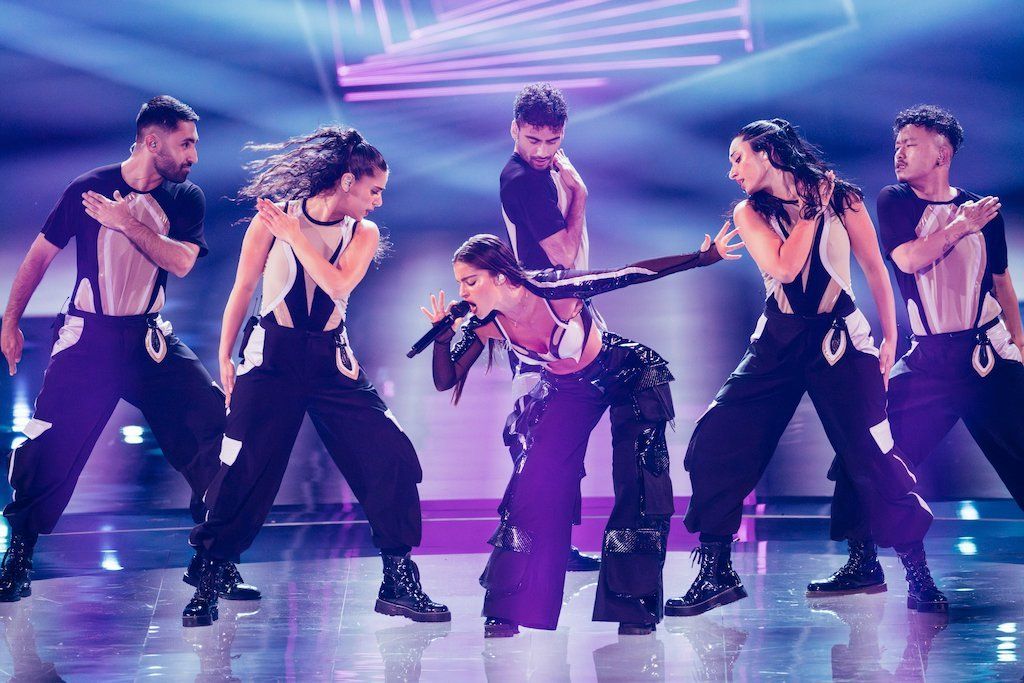
Acts
from Armenia, Poland and Israel - especially Israel - threw slick dance
breaks into their performances; while Italy's Marco Mengoni was
accompanied by two gymnasts on trampolines.
There
was also the usual surfeit of tortured ballads, both good (Lithuania)
and drab (Albania); and a never-ending parade of lyrics about coming
together and being nice to your neighbours (Belgium, Switzerland,
Australia).
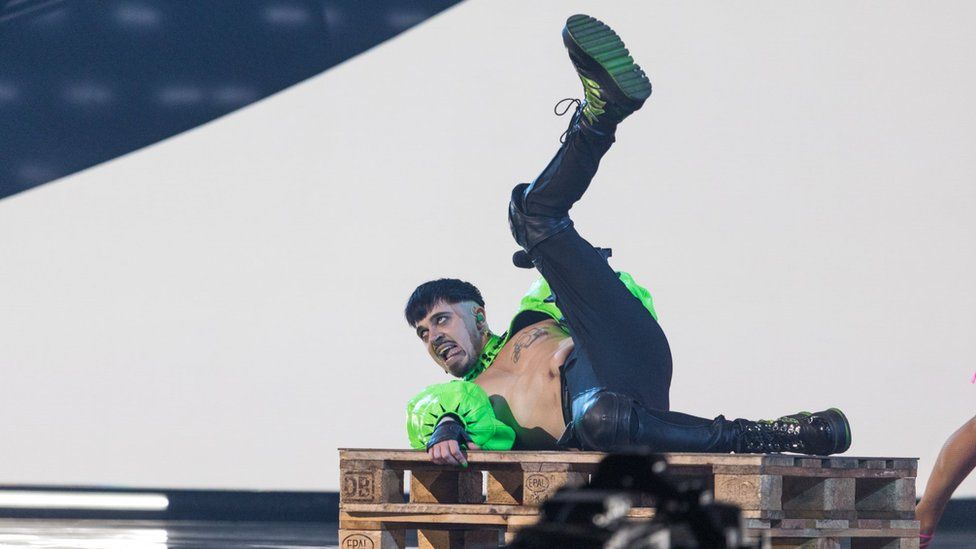
Finnish
rapper Käärijä was the runaway public favourite: He received more than
double Loreen's tally in the phone vote. But his chaotic mix of thrash
metal, hardcore techno and K-pop melodies failed to impress the juries,
who are comprised of music experts.
In a post-modern twist, the competition was bookended by two songs about the process of songwriting.
Austrian
duo Teya & Salena kicked off the show with the quirky pop anthem
Who The Hell Is Edgar, in which they are possessed by the spirit of US
poet Edgar Allen Poe, who compels them to write a song.
An
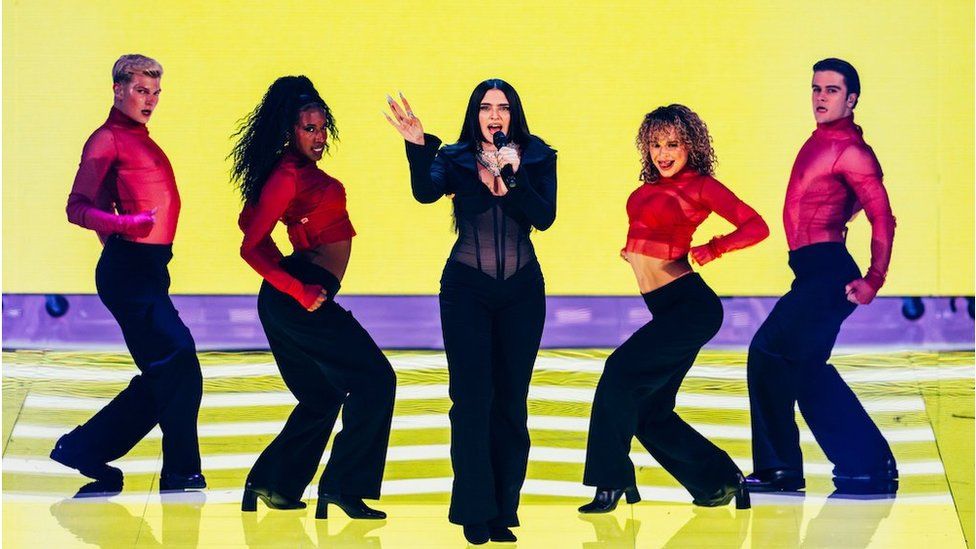
hour-and-a-half later, Mae Muller closed the competition with I Wrote A
Song - in which she gets revenge on her ex-boyfriend by writing a song
that catalogues his misdemeanours.
It
meant the contest opened with the lyric, "Oh my God, you're such a good
writer", and ended with Muller singing, "Instead, I wrote a song".
And if that's not synchronicity, I don't know what is.
The
contest was presented by Alesha Dixon, Hannah Waddingham and Ukrainian
singer Julia Sanina, with Graham Norton joining them during the voting
stage.
The
interval showcased the "Liverpool songbook" with tracks by John Lennon,
Melanie C and Gerry and the Pacemakers performed by former Eurovision
contestants.
And
Sam Ryder, who came second for the UK last year, performed an emotional
version of his new single, Mountains, with Queen's Roger Taylor on
drums.
Ryder, whose song is about overcoming adversity, was accompanied on stage by dancers who had lost limbs.
How the votes came in
Loreen
easily won the jury vote, picking up the maximum 12 points from
Ireland, Estonia, Spain, Albania, Cyprus and Ukraine, among others.
She ended the jury sequence with a score of 340, giving her a comfortable 163-point lead over Italy's Marco Mengoni.
The public preferred Finnish rapper Käärijä, giving him 526 points, temporarily putting him in the lead.
After a tense pause, Loreen reclaimed the crown at the last minute, receiving a public score of 243 that put her back on top.
The UK languished at the bottom of the table, picking up just nine points from the public and 15 from the juries.
Only Germany fared worse. Their glam-rock song Blood And Glitter gained a mere 18 points.
Commiserations came from the BBC, who organised the contest in partnership with the European Broadcasting Union.
The
broadcaster's official Twitter account posted: "Mae, we're so proud of
you and everything you've achieved at this year's Eurovision Song
Contest."

